As the country approaches 150 million vaccinated people, the pace of the rollout has been slowing, signaling a new phase of the campaign in which supply in many areas exceeds demand. The average number of people getting a first or single dose each day has fallen by about 50 percent from the peak on April 13.
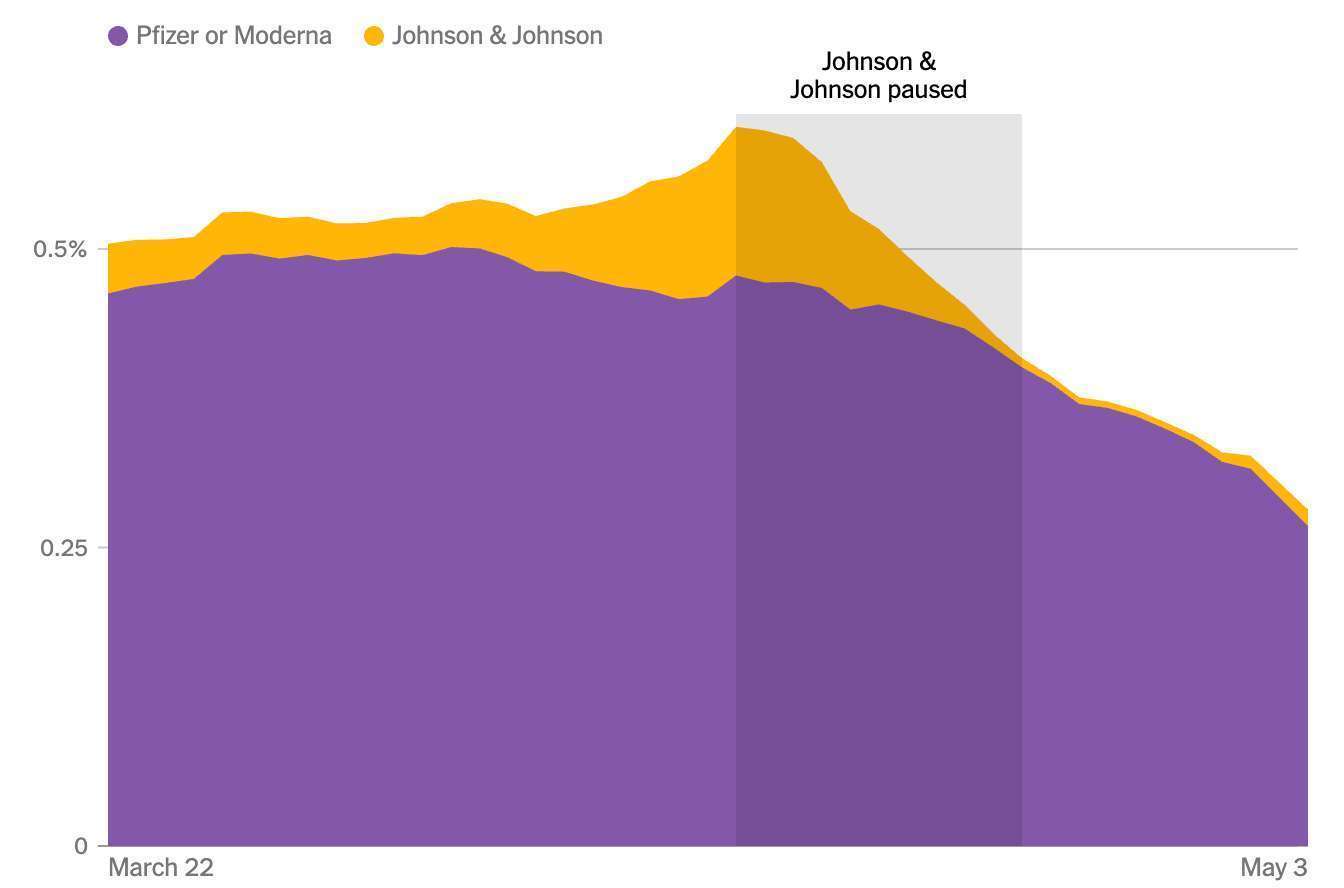
Vaccinations fell sharply in the days after April 13, when health officials announced a pause on the Johnson & Johnson vaccine to investigate reports of rare side effects, and they have not fully recovered. Experts say the 11-day pause is partly responsible, but the data also shows a slowing uptake of the Pfizer and Moderna vaccines.
“It’s a factor, but not the major factor,”
Dr. Cyrus Shahpar, the White House’s Covid-19 data director, said of the Johnson & Johnson pause.
The Johnson & Johnson vaccine has started to return across the country, but it’s too soon to say how much its use will rebound. A Survey Monkey poll by Boston Children’s Hospital shows that willingness to take Johnson & Johnson fell during and after the pause, especially among women, but that interest in getting the one-dose shot is slowly returning.
Health officials say the national deceleration was an inevitable part of the rollout, after reaching the people most eager to get their shots in most states. The decline is visible in the data for those seeking their first or second shots, but also for total doses administered, which peaked at slightly above three million shots a day, just before the pause took effect.
“The idea that this would be a linear increase and we would hit a million shots a day, two million shots a day, three million shots a day, four, four and a half, and then keep rising at that rate, we never really anticipated that,” said Ben Wakana, deputy communications director for the White House’s Covid-19 response team. “We believe we will continue vaccinating millions of people a day.”